-
-
Connect to external services over SSH
-
-
-
This content has been machine translated dynamically.
Dieser Inhalt ist eine maschinelle Übersetzung, die dynamisch erstellt wurde. (Haftungsausschluss)
Cet article a été traduit automatiquement de manière dynamique. (Clause de non responsabilité)
Este artículo lo ha traducido una máquina de forma dinámica. (Aviso legal)
此内容已经过机器动态翻译。 放弃
このコンテンツは動的に機械翻訳されています。免責事項
이 콘텐츠는 동적으로 기계 번역되었습니다. 책임 부인
Este texto foi traduzido automaticamente. (Aviso legal)
Questo contenuto è stato tradotto dinamicamente con traduzione automatica.(Esclusione di responsabilità))
This article has been machine translated.
Dieser Artikel wurde maschinell übersetzt. (Haftungsausschluss)
Ce article a été traduit automatiquement. (Clause de non responsabilité)
Este artículo ha sido traducido automáticamente. (Aviso legal)
この記事は機械翻訳されています.免責事項
이 기사는 기계 번역되었습니다.책임 부인
Este artigo foi traduzido automaticamente.(Aviso legal)
这篇文章已经过机器翻译.放弃
Questo articolo è stato tradotto automaticamente.(Esclusione di responsabilità))
Translation failed!
Connect to external services over SSH
You often need to reach systems outside your workspace over SSH — to push to a Git repository hosted on Azure DevOps, deploy to a staging server, or open a session on a remote database host.
By default the SecurSpaces proxy service blocks outbound SSH from workspaces. One of two options must be enabled first, and both are enabled by a project owner or security officer:
| Option | What you do | What your administrator does |
|---|---|---|
| Personal SSH Identity | Generate your own key in your profile and register the public key on the target service | Switches on Enable Personal SSH Identity for the workspace or template |
| Connected SSH Services | Nothing. Run ssh <service-name>. |
Creates the service with its credentials and attaches it to the workspace |
If neither is enabled, see Outbound SSH is blocked.
Administrators should see Enable outbound SSH.
Option 1: Personal SSH Identity
The platform generates and holds an SSH key pair for you. The private key is applied automatically when you connect and is never exposed inside the workspace.
Prerequisite: a project owner or security officer has switched on Enable Personal SSH Identity for your workspace or its template.
Generate your key
- Select your profile picture in the top-right corner to open your profile.
- Go to Integrations > Personal SSH Identity.
- Select Generate Key.
- Enter a default user name, for example
git. You can override it per service when you connect. - Select Create.
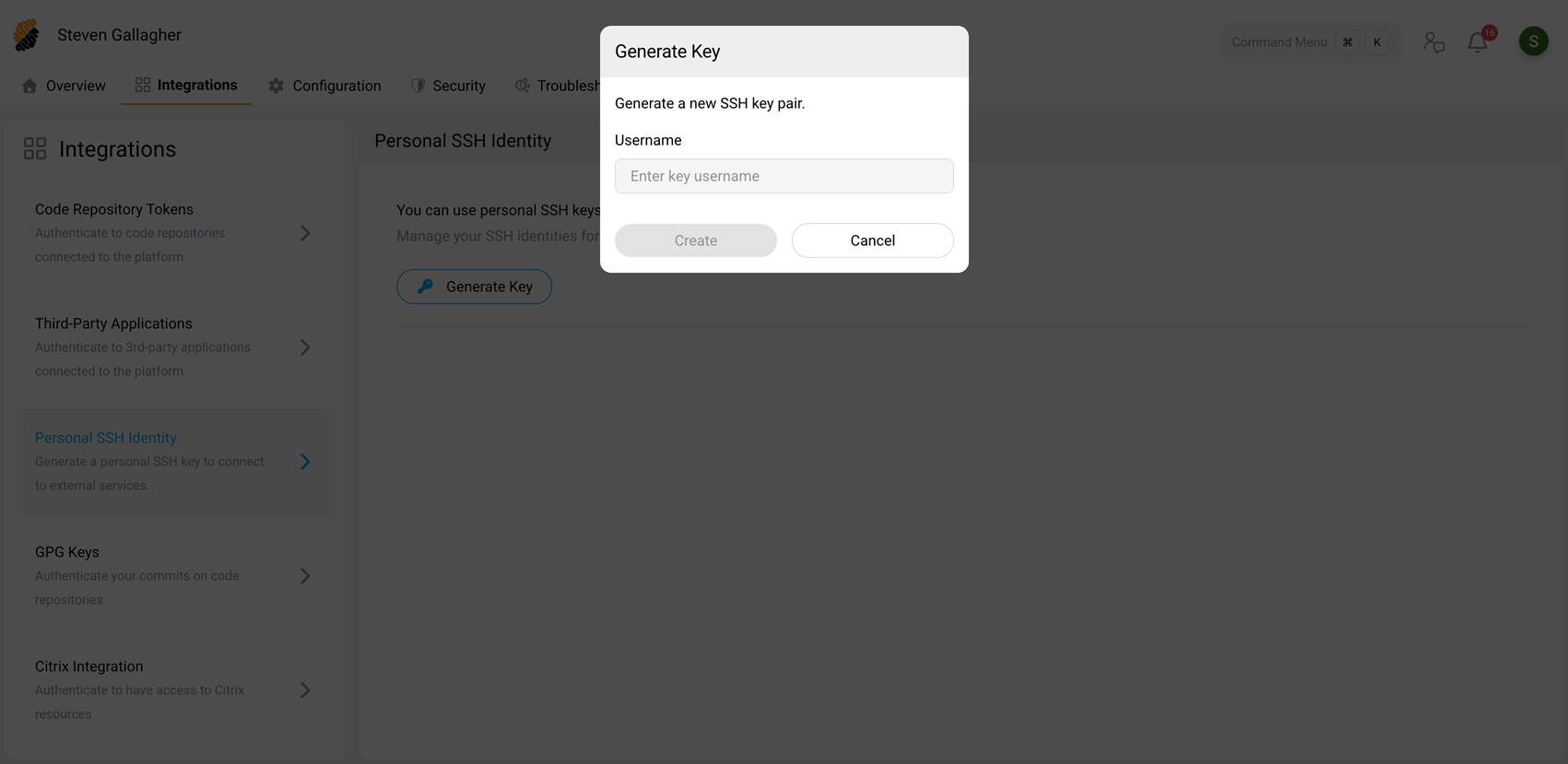
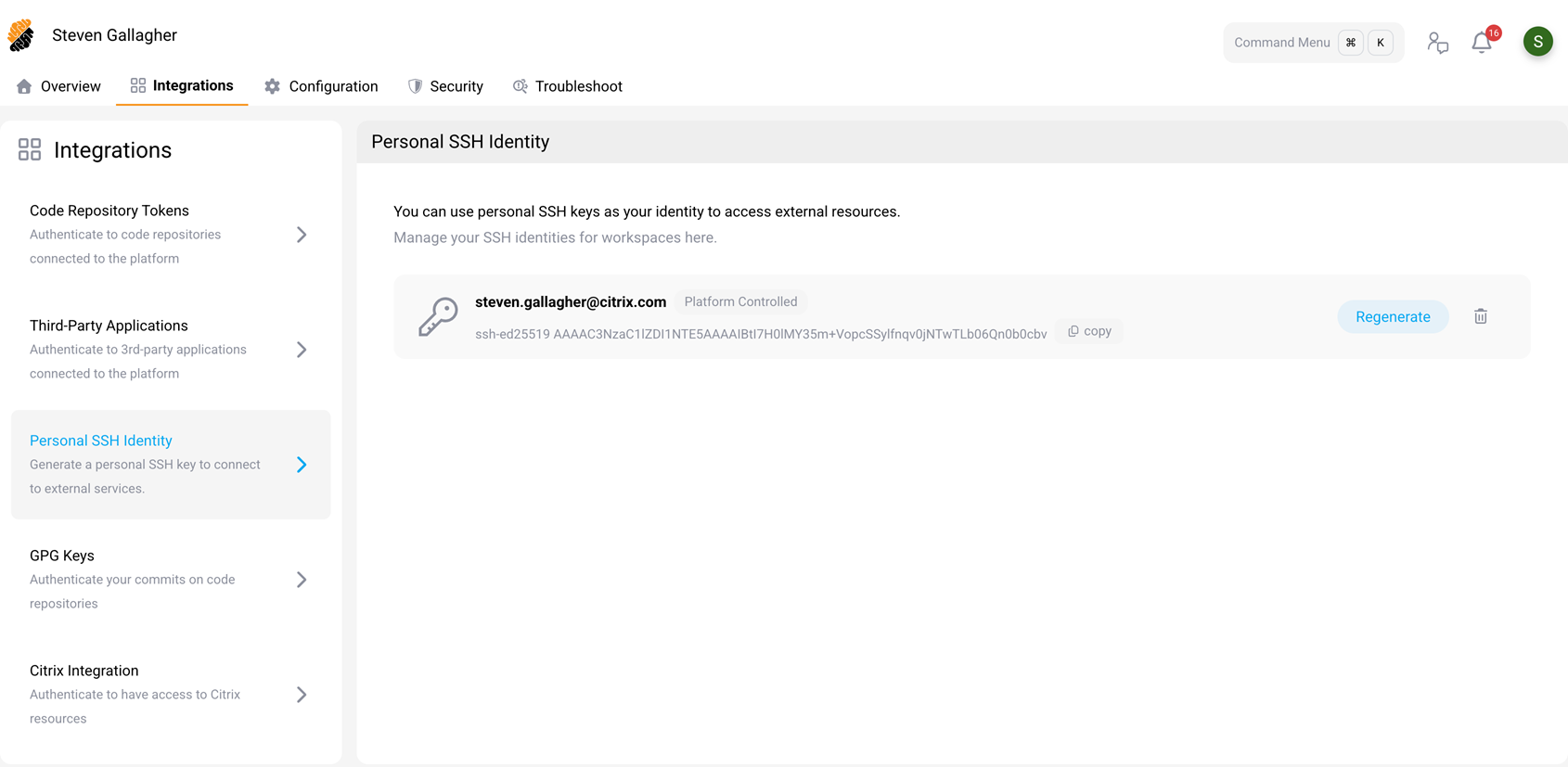
The platform generates the pair and shows the public key. The key applies to new and existing workspaces.
Register the public key
- On the Personal SSH Identity page, select Copy.
- Add the public key to the target service, for example by appending it to
~/.ssh/authorized_keyson the host. The exact steps depend on the service.
Connect
Open a terminal in any workspace where Personal SSH Identity is enabled and connect as usual:
ssh <username>@<hostname>
<!--NeedCopy-->
SecurSpaces applies your private key. There is no key to manage inside the workspace.
Option 2: Connected SSH Services
Your administrator defines the target host and its credentials once, then attaches it to the workspace. You do not handle a key or a password.
Open a terminal in the workspace and use the service name as the host:
ssh gcp-vm
<!--NeedCopy-->
SecurSpaces authenticates you automatically.
Outbound SSH is blocked
If no SSH method is configured for the host you are reaching, the proxy closes the session and the terminal
shows this before it does. Depending on the client, you might also see no signers found for request or
ssh: no auth passed yet, which mean the same thing — the workspace has no SSH credential to present.
SSH access to external hosts is disabled by default in this workspace.
To connect, an administrator must enable one of:
  - Personal SSH Identity (per-user key) - in the workspace/template Security Settings
  - a Connected SSH Service - then run: ssh <service-name>
See: https://docs.citrix.com/en-us/securspaces/workspace/ssh-connectivity
<!--NeedCopy-->
Ask a project owner or security officer to enable one of the two options. Personal SSH Identity suits access to your own accounts; a Connected SSH Service suits a host the whole team uses.
Note:
This message appears only when the SSH connection itself is blocked for lack of a configured method. A connection that fails because the destination is not on an allow list is a network policy matter. See Monitor and troubleshoot.
Related information
Share
Share
This Preview product documentation is Citrix Confidential.
You agree to hold this documentation confidential pursuant to the terms of your Citrix Beta/Tech Preview Agreement.
The development, release and timing of any features or functionality described in the Preview documentation remains at our sole discretion and are subject to change without notice or consultation.
The documentation is for informational purposes only and is not a commitment, promise or legal obligation to deliver any material, code or functionality and should not be relied upon in making Citrix product purchase decisions.
If you do not agree, select I DO NOT AGREE to exit.