This content has been machine translated dynamically.
Dieser Inhalt ist eine maschinelle Übersetzung, die dynamisch erstellt wurde. (Haftungsausschluss)
Cet article a été traduit automatiquement de manière dynamique. (Clause de non responsabilité)
Este artículo lo ha traducido una máquina de forma dinámica. (Aviso legal)
此内容已经过机器动态翻译。 放弃
このコンテンツは動的に機械翻訳されています。免責事項
이 콘텐츠는 동적으로 기계 번역되었습니다. 책임 부인
Este texto foi traduzido automaticamente. (Aviso legal)
Questo contenuto è stato tradotto dinamicamente con traduzione automatica.(Esclusione di responsabilità))
This article has been machine translated.
Dieser Artikel wurde maschinell übersetzt. (Haftungsausschluss)
Ce article a été traduit automatiquement. (Clause de non responsabilité)
Este artículo ha sido traducido automáticamente. (Aviso legal)
この記事は機械翻訳されています.免責事項
이 기사는 기계 번역되었습니다.책임 부인
Este artigo foi traduzido automaticamente.(Aviso legal)
这篇文章已经过机器翻译.放弃
Questo articolo è stato tradotto automaticamente.(Esclusione di responsabilità))
Translation failed!
Data buckets
A Data Bucket is used for general, unstructured storage of data online. This is basically a folder in S3 format that is commonly used to store and access large datasets. Most cloud vendors offer S3 data buckets as a general storage data mechanism. The platform supports buckets from vendors such as Azure, Google and Amazon Web Services. They are particularly popular for Data Science applications.
Data Buckets allow you to use your external datasets inside a workspace. A data bucket attached to a workspace is automatically mounted as a folder to the container’s filesystem.
As for the other types of resources, data buckets are first imported to the platform such that they become available when creating or updating the configuration of a workspace.
View Data Buckets
Data Buckets used in the project are being displayed. You may filter those in use.
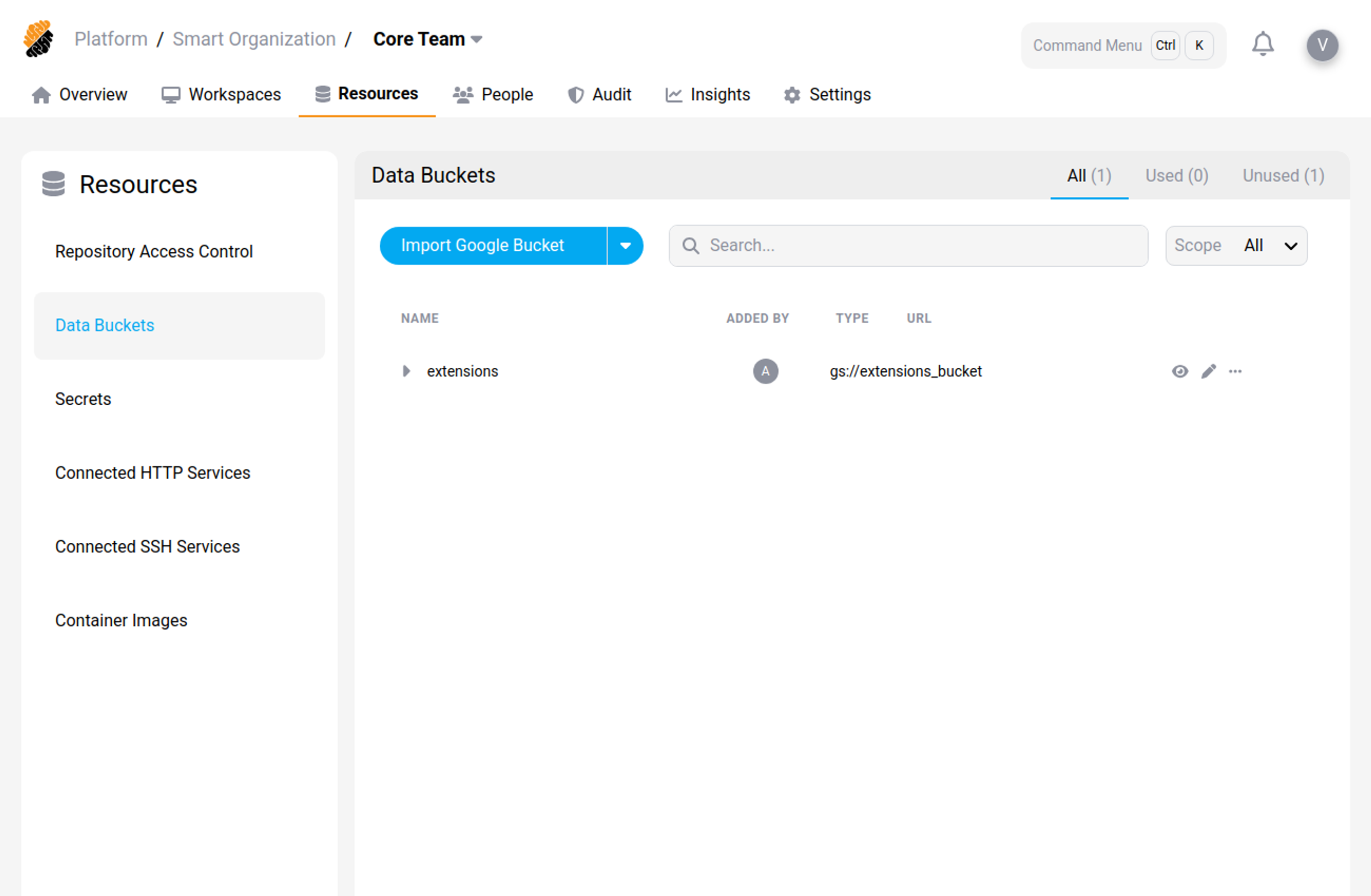
A Data Bucket is defined by the following characteristics:
- Basic information: Information such as name, the user who added it, service provider (Google, Amazon or Microsoft) and URL.
- Class Level: This option defines the visibility for the container based on the user’s permissions.
- Permissions: This option lets you define access to a data bucket as read or read and write.
- Asset Information: This option allows for providing a description of the data bucket.
The platform provides a mechanism to create versions of buckets. A new version is created when data is uploaded to a bucket from a workspace (with write access). By clicking on a bucket you can see a list of versions followed by basic details (creation date, size, status, connections) as well as its content by clicking on the book icon.
To upload data from a workspace, the workspace must already be attached to the Data Bucket and must have write access. If the workspace is not attached or has read-only access, choose another workspace or update the workspace’s resource access before uploading.
Import a Data Bucket
Requires the Resources permission set to Manage.
The import button names the provider it will use, so it reads Import Google Bucket, Import Amazon Bucket, or Import Microsoft Bucket. Select the provider that matches your bucket before importing.
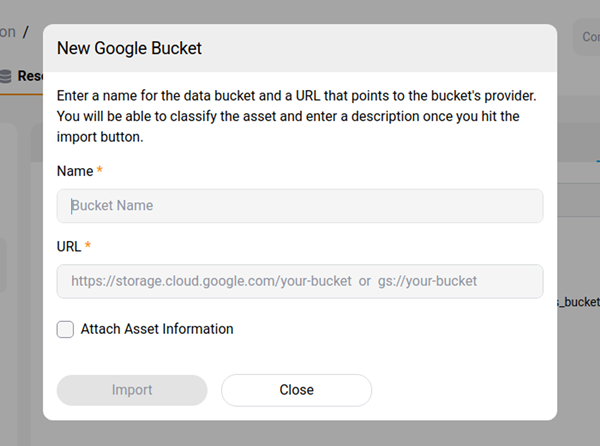
The form opens as New Google Bucket, New Amazon Bucket, or New Microsoft Bucket, and asks for:
- Name, a name to identify the data bucket.
- URL, which points to the cloud provider’s storage location.
- Attach Asset Information (optional), a description of the bucket.
Select Import to save it.
Info
When importing Amazon buckets, you need to specify its region to optimize the data access performance.
Related information
Share
Share
In this article
This Preview product documentation is Citrix Confidential.
You agree to hold this documentation confidential pursuant to the terms of your Citrix Beta/Tech Preview Agreement.
The development, release and timing of any features or functionality described in the Preview documentation remains at our sole discretion and are subject to change without notice or consultation.
The documentation is for informational purposes only and is not a commitment, promise or legal obligation to deliver any material, code or functionality and should not be relied upon in making Citrix product purchase decisions.
If you do not agree, select I DO NOT AGREE to exit.